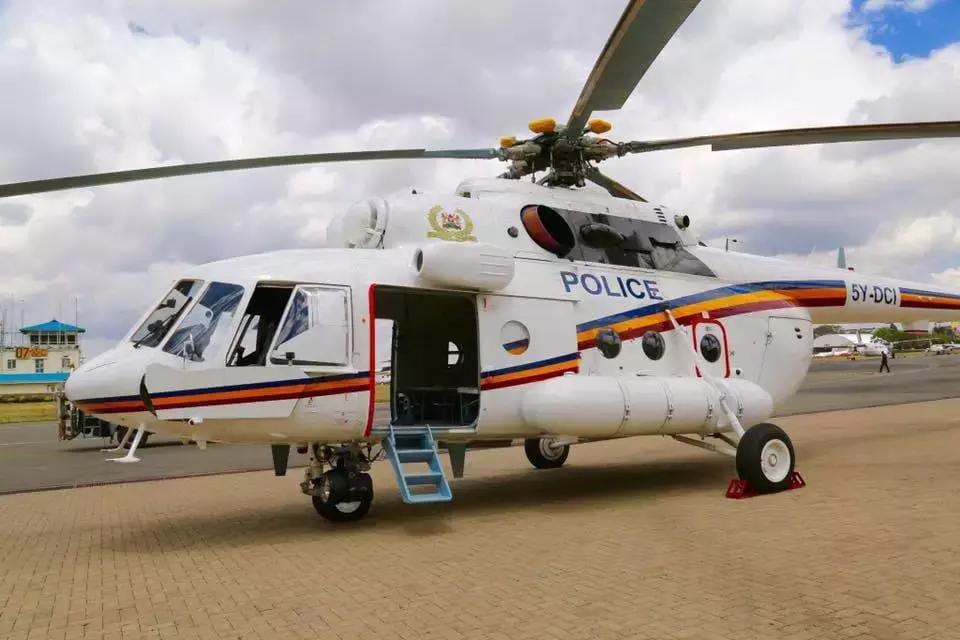
An audit by the Ethics and Anti-Corruption Commission has exposed critical challenges within the National Police Service Air Wing, revealing that only two out of 11 aircraft are currently fit for use, while the rest remain grounded due to persistent mechanical faults and a shortage of spare parts.
The review, requested by Inspector General of Police Douglas Kanja in February, assessed the Air Wing’s operations, policies, maintenance practices, and management systems to identify gaps affecting performance and potential corruption risks.
“At the time of the examination, out of the air wing's fleet, only two were operational while the rest were grounded due to poor maintenance and lack of spare parts,” the report states.
The audit highlights that grounding most of the fleet has weakened the Air Wing’s efficiency, emergency response, and contribution to national safety. The commission recommends urgent attention to restore aircraft readiness.
“The Inspector General should allocate adequate resources for fleet maintenance to restore airworthiness. A comprehensive maintenance plan should be put in place to repair grounded aircraft and procure necessary spares, while any unsafe or beyond economic repair airframes should be disposed of,” the report reads.
Interviews with the Air Wing commandant and deputy commandant revealed structural and administrative difficulties.
The unit reports functionally to Deputy IG Eliud Lagat but remains under IG Kanja’s overall control, causing overlapping responsibilities and slowed decision-making.
The audit also raised concerns about the Internal Affairs Unit, which has yet to expand fully to county offices. With only 74 staff instead of the recommended 1,168, including 10 non-uniformed officers, the report notes, “Understaffing is a weakness that crippled the actualisation of the unit's mandate, hindering effective service delivery.”
IAU officers are drawn from the Kenya Police Service, Administration Police, and Directorate of Criminal Investigations and can be redeployed at the IG’s discretion.
In March 2024, 53 out of 120 officers were reassigned, leaving only 67, and 30 of these were later sent for promotional training, reducing available staff to 27. The report further highlights that the unit has no structured system for reporting back to complainants, informants, or whistleblowers.
Based at Wilson Airport, the Air Wing handles search and rescue, casualty evacuation, anti-terror missions, VIP protection, crime prevention, and aerial patrols.
Yet most aircraft are grounded due to aging fleets, funding gaps, and maintenance delays. The two Mi-17 helicopters acquired in 2017 remain the only operational machines.
Public attention focused on the Air Wing after a Mi-17 helicopter, registered 5Y-SFA, made a hard landing during a rescue operation in Marakwet East on November 3. The aircraft had previously made emergency landings in Mulot, Bomet, and in November 2019, though no fatalities occurred.
The unit was certified in April 2025 by the Kenya Civil Aviation Authority as an Approved Aircraft Maintenance Organisation. Deputy IG Eliud Lagat called it historic, and Commandant Captain James Kabo said the aim was to become a regional benchmark in aviation.
However, repeated emergencies, past crashes, and the audit findings show that operational safety and fleet readiness remain critical challenges. The Air Wing has a history of accidents, including the 2012 crash that killed former Internal Security Minister George Saitoti and his deputy Joshua Orwa Ojode.
A 2023 government review led by former Chief Justice David Maraga stressed the Air Wing’s urgent modernisation, describing it as “a critical national asset whose operational capacity must not be compromised.”































Comments
Sign in with Google to comment, reply, and like comments.
Continue with Google